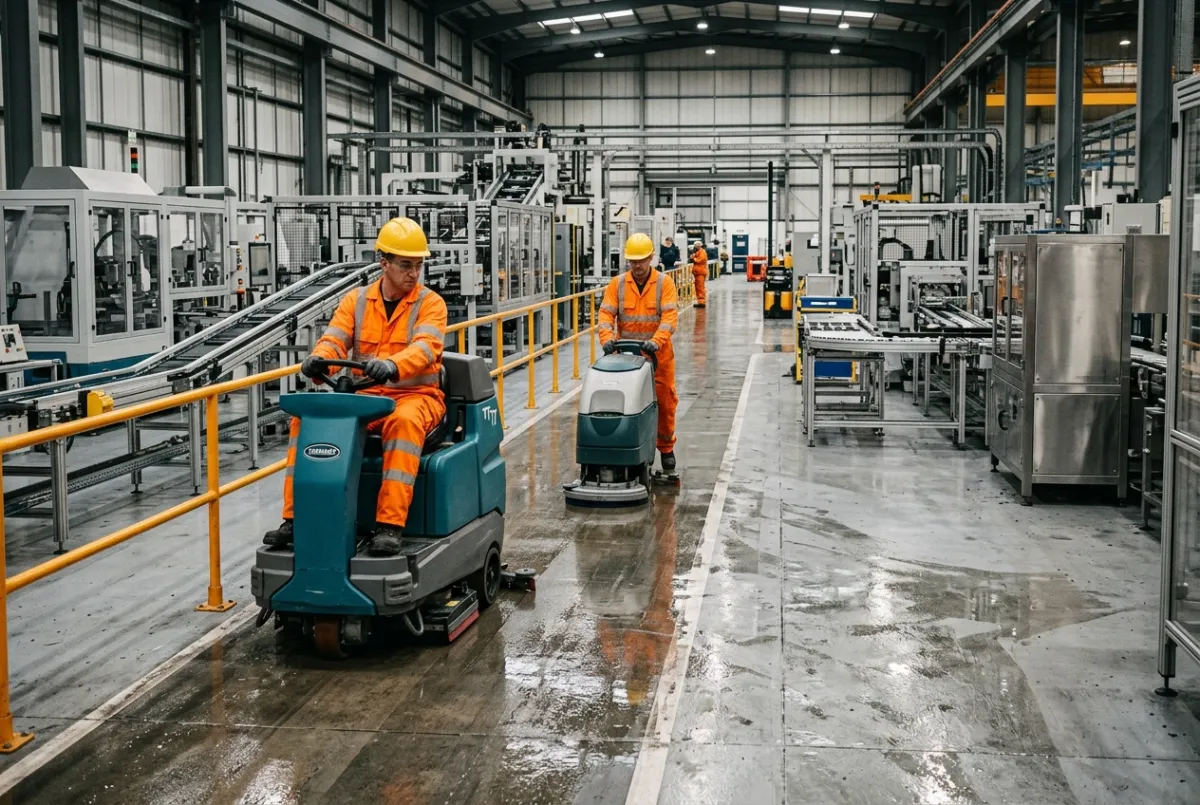
North West and North Wales Factory & Production Facility Cleaning for Safer Output Areas and Lower Unplanned Downtime
North West and North Wales Factory & Production Facility Cleaning for Safer Output Areas and Lower Unplanned Downtime
Factory and production facility cleaning has the biggest impact when it improves how a site actually runs, not just how it looks at the end of a shift. Across the North West and North Wales, industrial facilities often combine manufacturing, packaging, warehousing, engineering and dispatch functions in the same live environment. When dust, residue, spills and general build-up are allowed to spread through those areas, the effect is usually wider than simple housekeeping. Inspection becomes harder, access routes become less predictable and maintenance teams lose time preparing areas before they can begin higher-value work.
Alternative Cleaning Solutions NW Ltd promotes industrial cleaning support across factories, warehouses, engineering facilities, logistics environments and industrial commercial premises throughout the North West and North Wales. The homepage also states that industrial cleaning can be scheduled around operational requirements, shutdown periods and maintenance windows, which makes the service practical for production-led sites that cannot simply stop activity whenever cleaning is required.
What factory and production facility cleaning usually covers
On industrial sites, the scope often includes production floors, work zones, access routes, shared operational areas, residue around equipment, surface contamination and the daily dirt load that accumulates wherever materials, people and machinery are moving continuously. The homepage also confirms that industrial deep cleaning may include floor cleaning, machinery cleaning, high-level cleaning and removal of industrial contamination, dust and operational residue.
That means a production-facility clean is often the foundation layer for more technical follow-on work. A wider site reset may naturally lead into plant and machinery industrial cleaning where equipment needs more detailed treatment, or into industrial shutdown cleaning services where a maintenance window offers the best moment to clean more deeply and hand areas back in a better condition.
Why regional sites plan factory cleaning rather than waiting
A facility in Liverpool, Manchester, Cheshire, Lancashire, Cumbria or North Wales may operate differently day to day, but the pattern is usually similar: once contamination begins interfering with output areas, the problem spreads through adjacent spaces faster than managers expect. Production teams work around dirt, forklifts move residue from one zone to another and engineering teams spend time making areas workable before they can inspect or repair equipment.
There is also a safety and planning dimension. HSE explains in its guidance on risk assessment that employers should identify hazards, assess how harm could occur and take action to eliminate or control the risk. That principle is directly relevant to factory cleaning because active production spaces are shared environments where contamination, slips, blocked access and poor visibility often interact with the way the site operates.
Typical cost ranges and timeframes
ACS does not publish fixed prices, which is normal because industrial cleaning varies widely by facility size, contamination type, working hours and access restrictions. As a planning guide rather than a fixed tariff, smaller factory and production-facility cleaning works across the North West and North Wales may start in the high hundreds where one operational area or one production hall needs attention. Broader programmes involving multiple bays, heavier residue, weekend work or phased attendance around output schedules more often move into the low thousands.
A focused clean of one area may fit into a single shift if access is straightforward. A wider facility reset commonly takes one to three days, particularly where the site remains live and work has to be phased around production, staffing and deliveries.
| Cleaning format | Best fit | Typical timing | Main benefit |
|---|---|---|---|
| Targeted production-area clean | One output zone or one hall | One shift | Fast improvement in local standards |
| Multi-area facility clean | Several linked work zones | 1-2 days | Better site-wide housekeeping |
| Deep production reset | Heavier residue across active areas | 1-3 days | Stronger support for inspections and maintenance |
| Recurring planned programme | Sites with regular build-up | Scheduled attendance | More predictable standards over time |
How to get more value from production cleaning
Start where contamination affects operations first
The best place to begin is usually not the most visible area but the area where build-up most directly affects output, access or safety. That may be around line-side zones, packing areas, goods transfer points or shared work routes.
Match the cleaning window to the production cycle
Regional industrial sites often operate across tight schedules, variable shifts and delivery windows. Cleaning works best when planned around those cycles so the team can access the space properly rather than trying to work around every live constraint at once.
Use broader regional experience, not a generic checklist
A contractor working across the North West and North Wales will usually understand the practical differences between a heavy engineering unit, a processing facility and a warehouse-backed production site. That matters because the right cleaning scope depends on how the site functions, not only on what appears dirty at the surface.
Signs a production facility needs a proper reset
If staff are repeatedly working around contamination, if output areas do not stay clean after routine housekeeping, if engineering teams need to pre-clean before inspections, or if audits keep flagging inconsistent standards, the site usually needs a structured factory-cleaning plan rather than more reactive attendance.
FAQ
What is included in factory and production facility cleaning?
It usually includes production floors, output areas, access routes, shared operational spaces, contamination removal and practical housekeeping support that restores a cleaner working condition.
What affects cleaning cost across the North West and North Wales?
The main factors are facility size, contamination severity, number of zones, access complexity, working hours and whether the site must remain fully operational during the clean.
Can factory cleaning happen outside standard hours?
Yes. The homepage states that projects can be scheduled around operational requirements, shutdown periods and maintenance windows to minimise disruption.
How often should production facilities be professionally cleaned?
That depends on output levels, dust or residue generation and the operational environment, but sites with recurring build-up usually benefit from planned programmes rather than purely reactive cleans.
CTA
If your output areas need cleaner conditions, better housekeeping and lower disruption to everyday operations, request a quote from Alternative Cleaning Solutions NW Ltd for factory and production facility cleaning across the North West and North Wales.
